



About Us
Welcome to Coast Package Material. Your trusted partner for various packaging products!
Contact UsContact Info
- Operation Center : 365 Hu Tai Road, Shanghai, China, 200070
- +86 18158186165
- info@coastpackage.com
Welcome to Coast Package Material. Your trusted partner for various packaging products!
Contact Us
Oct 8,2026
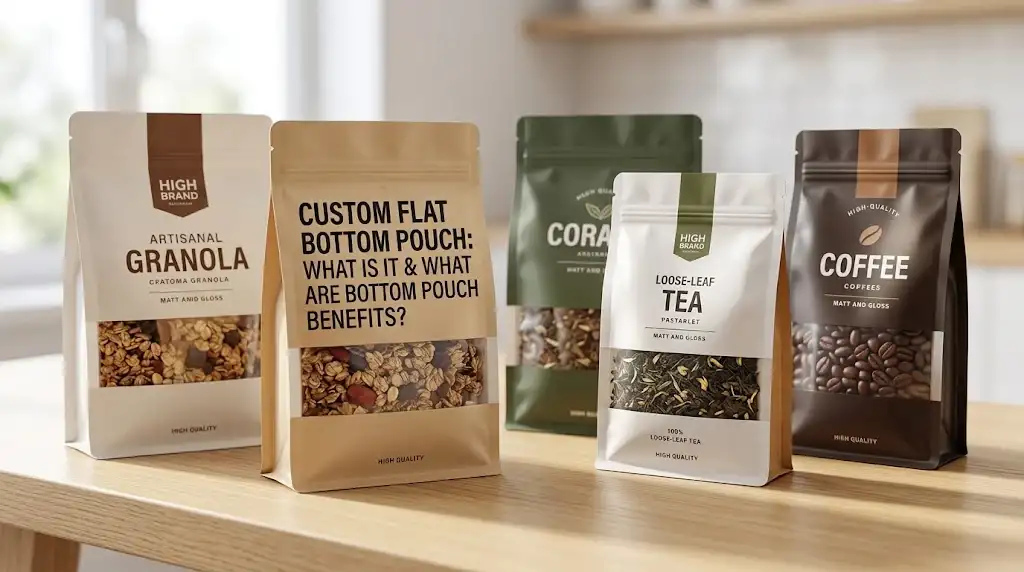
Flat bottom pouches are a flexible packaging format that combines the convenience of a pouch with the stable, structured look of a box. Their rectangular base lets the filled package stand upright, while side gussets add volume and panel space for branding and product information. They are also commonly called block bottom pouches, box pouches, or flat bottom bags.
For manufacturers, food brands, coffee companies, pet food suppliers, and other businesses evaluating flexible packaging, the main question is not simply whether a flat bottom pouch looks attractive. The more important question is whether its construction, material, barrier level, size, closure, and other features match the product and packaging requirements.
A flat bottom pouch is a flexible bag with a structured rectangular base and side gussets. When filled, these components create a box-like shape that lets the package stand upright on a shelf or other flat surface. Coast Package describes flat bottom and block bottom pouches as the same general packaging format, with available display space across the front, back, side gussets, and bottom.
This construction gives the pouch a more defined footprint than a conventional flexible bag. It can also provide more usable surface area for printed branding, product information, and other packaging graphics.
Don't confuse the flat bottom with a simple flat pouch. A flat pouch has no structured bottom and is typically designed for lightweight or single-use applications, while a flat bottom pouch is designed to form a stable base when filled.
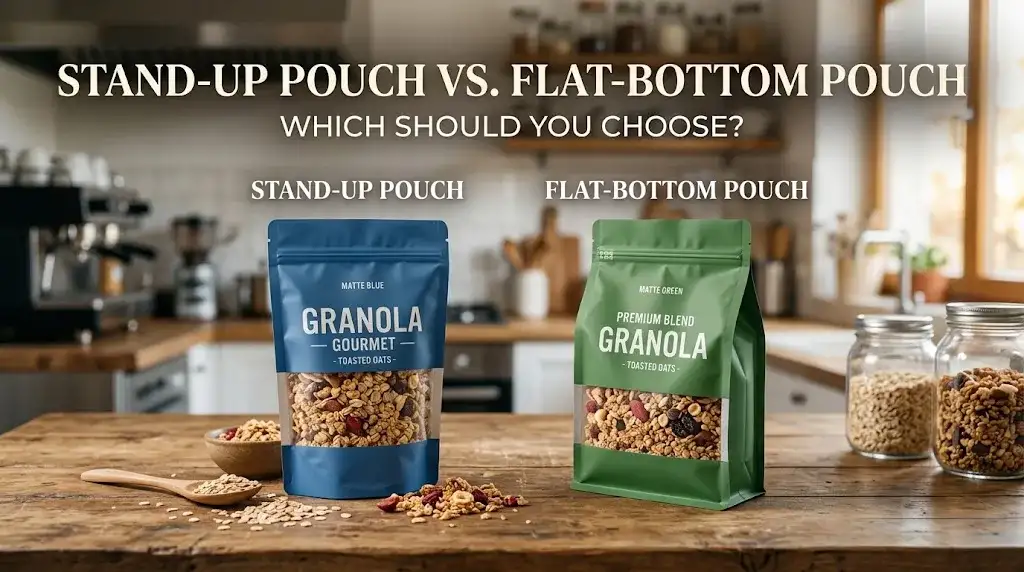
Both formats are designed to stand upright, but they achieve this through different constructions.
A stand-up pouch generally uses a bottom gusset that expands as it fills. A flat bottom pouch uses a rectangular base combined with side gussets, giving it a more structured, box-like footprint.
| Consideration | Flat Bottom Pouch | Stand-Up Pouch |
|---|---|---|
| Base construction | Rectangular flat base with side gussets | Bottom gusset |
| Overall appearance | Structured, box-like | Flexible and rounded |
| Shelf stability | Strong upright presentation | Good, depending on product and fill |
| Branding area | Front, back, side gussets, and base | Mainly front and back panels |
| Manufacturing complexity | Generally more complex | Generally simpler |
| Cost | Can be higher than stand-up pouches | Often more economical |
| Typical applications | Coffee, pet food, premium dry foods, grains | Snacks, powders, tea, samples, and many dry goods |
There is no universal winner. Stand-up pouches can be a practical choice when lower cost and flexible packaging are priorities. At the same time, flat bottom pouches can be more appropriate when shelf stability, larger fill volumes, structured presentation, or multiple printable panels are important.
The rectangular base gives the filled pouch a stable footprint and keeps it upright. This is especially useful for products displayed individually on retail shelves.
The structured shape also gives the package a more box-like appearance without requiring a rigid container. Coast Package positions block bottom pouches as a flexible alternative to conventional boxes for applications such as coffee and pet food.
A flat bottom pouch can provide several usable surfaces for printing. Depending on the construction, brands can use the front and back panels as well as the side gussets and bottom area for packaging information and visual elements.
That extra surface area can help products that need more than a simple front-facing label. Brands can allocate different panels to product descriptions, preparation instructions, nutritional information, branding, barcodes, or other required information.
The extra panel space is a branding opportunity, but it should not be treated as an automatic guarantee of higher sales. Packaging design, product positioning, pricing, distribution, and the overall customer experience also influence commercial performance.
One major advantage of flexible packaging is the ability to engineer multilayer film structures for specific product requirements. Different layers can provide functions such as printability, mechanical strength, oxygen and moisture barrier, and heat sealing.
Coast Package lists several material options for bottom pouches, including aluminum foil laminates, kraft-based structures, metalized films, and other customized constructions.
The key point is that barrier performance comes from the selected material structure, not simply the flat-bottom shape. A product sensitive to oxygen, moisture, light, or aroma may require a different laminate than a less sensitive dry product.
For example, aluminum foil blocks light, oxygen, moisture, and bacteria, which is why it is widely used in food and pharmaceutical packaging.
Flat bottom pouches can be customized with functional features based on the product and intended user experience.
Available options may include:
Coast Package currently lists these and other customization options across its flat and block bottom pouch products.
For coffee packaging, a one-way degassing valve can be particularly important. Freshly roasted coffee releases carbon dioxide after roasting, and a suitable valve lets gas escape while helping limit oxygen from entering the package.
Flat bottom pouches are not limited to one type of product. Current Coast Package applications include coffee, coffee beans, pet food, powders, snacks, tea, grains, and other food and non-food products.
The right pouch construction depends on the product's physical and protection requirements, not the product category alone.
Coffee is one of the strongest applications for flat bottom packaging. The upright shape can create a premium shelf presentation, while high-barrier structures and one-way degassing valves can be specified for roasted coffee products.
Coast Package currently offers flat-bottom coffee packaging using structures such as PET/AL/PE, with options including resealable zippers and one-way degassing valves.
Dry pet food and treats can benefit from the stable base and larger volume of a block-bottom format. Coast lists pet food and kibble among its flat-bottom applications.
For heavier fills, evaluate material structure, seal strength, dimensions, and bottom construction together rather than selecting a pouch based only on appearance.
Snacks, grains, nuts, dried foods, and similar products can be packaged in flexible bottom pouches. The required barrier level depends on the product's sensitivity to moisture, oxygen, light, and other environmental factors.
Powders and dry ingredients can also be packed in flat bottom pouches. Product density and fill weight become particularly important when selecting pouch dimensions and construction because the package must support the filled product while maintaining reliable seals.
Tea, herbs, spices, and specialty dry foods can use flat bottom formats when product protection and shelf presentation matter. Select the material based on the product's barrier and shelf-life requirements.
Start by choosing a pouch based on the product, not the artwork.
Start with the product's actual quantity and density. A pouch intended for 250 g of a dense powder may require different dimensions from a pouch holding 250 g of a lightweight snack.
Manufacturers should test the actual product fill rather than relying only on estimated dimensions or a digital mockup.
Consider whether the product needs protection from:
The selected laminate should provide the required performance while avoiding unnecessary material complexity.
Consider whether the package needs a standard heat seal, zipper, slider, tear notch, spout, or another opening system.
For products intended to be opened and closed multiple times, a resealable zipper may improve convenience. For coffee, a one-way degassing valve may be necessary depending on the product and filling requirements.
Decide how much information needs to appear on the package and how to distribute the printed areas across the panels.
Options can include matte or glossy finishes, clear windows, custom graphics, and multiple printing processes. Coast Package currently offers custom printing and several surface and accessory options for its bottom pouch products.
For custom packaging, discuss minimum order quantities, sampling, production schedules, artwork requirements, and shipping arrangements before placing an order.
Coast Package currently publishes custom bottom pouch specifications that include custom sizing and materials, printing options, sample availability, and production lead-time information. Because these commercial details can change, buyers should confirm current terms when requesting a quotation.
The answer depends on what you're comparing the pouch to.
Flexible packaging can use relatively small amounts of material and weighs less than many rigid packaging formats. Flexible Packaging Association information also highlights the resource efficiency and lightweight nature of flexible films.
However, a flat bottom pouch should not automatically be described as cheaper than every other pouch format. Its more structured construction can make it more complex and more expensive to produce than a stand-up pouch.
Total packaging cost can depend on:
The better question is whether the additional cost is justified by the required shelf presentation, functionality, product protection, and packaging performance.
Flat bottom pouches can be produced using different material structures, including recyclable or compostable options. Coast Package currently offers mono-material and compostable packaging options.
However, calling a pouch simply "eco-friendly" is too broad. Sustainability depends on the complete packaging structure, product protection requirements, local collection and recycling infrastructure, and end-of-life pathway.
The Flexible Packaging Association emphasizes evaluating sustainability across the packaging life cycle rather than judging it by a single material or characteristic.
For B2B buyers, a better approach is to ask the supplier exactly what materials are being used, whether the structure is designed for a particular recycling or composting system, and what documentation is available for the target market.
Before ordering custom flat bottom pouches, ask the supplier:
Getting these answers before production can reduce the risk of selecting a pouch that looks right but does not perform properly for the product.
What is a flat bottom pouch?
A flat bottom pouch is a flexible package with a rectangular base and side gussets that create a stable, box-like shape when filled. It is also commonly called a block bottom pouch or box pouch.
What is the difference between a flat bottom pouch and a stand-up pouch?
A flat bottom pouch uses a more structured rectangular base and side gussets, while a stand-up pouch typically relies on an expandable bottom gusset. Flat bottom pouches generally look more structured and can offer more printable surface area.
Are flat bottom pouches good for coffee?
Yes. Flat bottom pouches are widely used for coffee, and specialized versions can incorporate high-barrier material structures and one-way degassing valves. Coast Package currently lists coffee and coffee beans among its applications for block-bottom packaging.
Are flat bottom pouches recyclable?
Some flat bottom pouches can be designed using recyclable material structures, but recyclability depends on the complete pouch construction and the recycling infrastructure available in the intended market. A supplier should confirm the specific structure and applicable end-of-life route.
Can flat bottom pouches have zippers?
Yes. Flat bottom pouches can be produced with different resealable zipper configurations, including pull-tab and slider options, depending on the product and package design.
Can flat bottom pouches have a degassing valve?
Yes. One-way degassing valves are available for applications such as roasted coffee, where carbon dioxide needs to escape after roasting. Coast Package currently offers this feature on applicable bottom pouch products.
Are flat bottom pouches more expensive than stand-up pouches?
They can be. Flat bottom pouches generally involve a more complex construction than stand-up pouches, although the final price depends on the material, size, printing, accessories, order quantity, and other specifications.
Flat bottom pouches offer a practical combination of flexible packaging, upright stability, structured presentation, customizable barrier materials, and multiple closure and accessory options. Their strongest applications include coffee, pet food, snacks, powders, tea, grains, and other products where shelf presentation and product protection need to work together.
Select the right pouch based on the product, fill weight, barrier requirements, closure, printing needs, order quantity, and distribution conditions. A flat bottom pouch isn't automatically the best option for every product. Still, when you need a structured, shelf-ready format, it can offer advantages a conventional flexible pouch may not.
For businesses sourcing custom flat bottom pouches, working with a supplier that can match the material structure, dimensions, barrier requirements, printing, and functional features to the product is key to consistent packaging performance.