



About Us
Welcome to Coast Package Material. Your trusted partner for various packaging products!
Contact UsContact Info
- Operation Center : 365 Hu Tai Road, Shanghai, China, 200070
- +86 18158186165
- info@coastpackage.com
Welcome to Coast Package Material. Your trusted partner for various packaging products!
Contact Us
Oct 16,2026
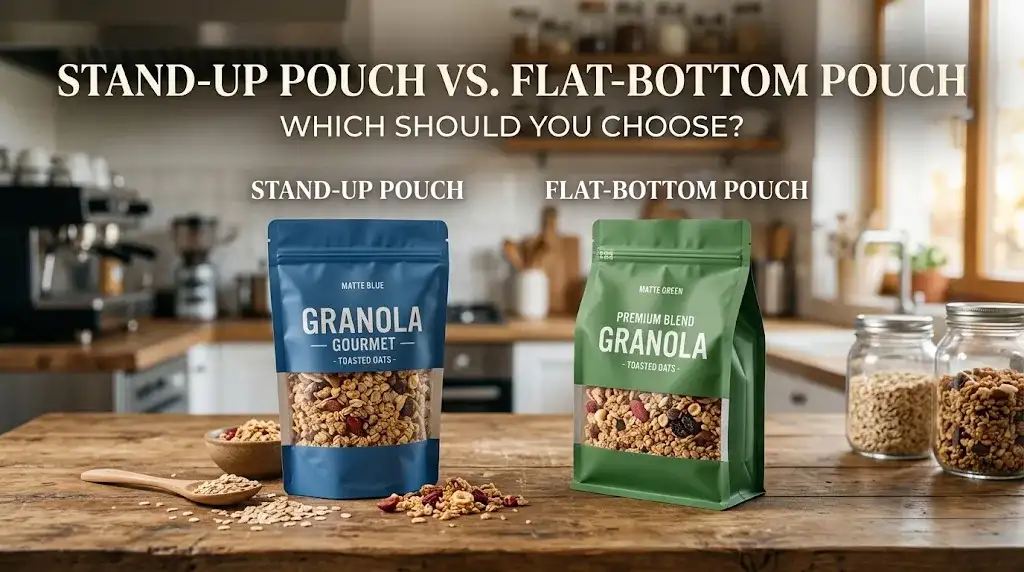
If you are sourcing pouches for coffee, pet food, snacks, or powders, you will hit this question early: stand-up pouch or flat-bottom pouch? Both stand on a shelf. Both can take a zipper. Side by side, they look alike, yet the quotes you get back can look very different.
The right choice depends on what goes inside, how heavy the fill is, how the product is sold, and how much print space you need. This guide covers the real differences so you can brief a supplier with the right questions.
Pick a stand-up pouch if you want the simpler, usually more economical build and a wide range of sizes and closures. Pick a flat-bottom pouch, also called a block Bottom pouch, if a box-like shape, extra print panels, and a steady base matter more. That is often true for coffee and heavier fills like pet food.
Neither format wins every time. Product, fill weight, barrier needs, and sales channel decide it.
A stand-up pouch has a bottom gusset, a fold of film that opens as the pouch fills and forms a base. The base is rounded, so the pouch keeps a softer outline. The wide front and back panels are the main print areas, which is why they work well as a billboard for your brand.
Stand-up pouches take most common add-ons: resealable zippers, slider closures, spouts, tear notches, hang holes, clear windows, and matte or gloss finishes. Spout versions suit liquids. Coast Package lists spout pouches for products such as cleaner and baby food.
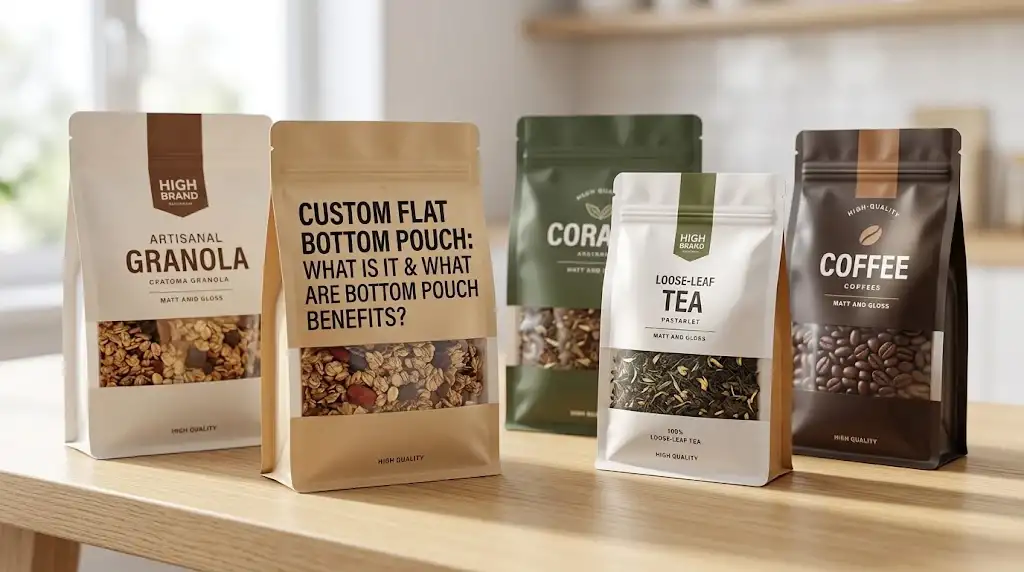
A flat-bottom pouch has a squared base formed by folding and sealing the Bottom into a rectangle, plus two side gussets. Once filled, it looks like a small box. You will also see it called a block bottom pouch, box bottom pouch, or box pouch. These names describe the same format.
Do not confuse it with a flat pouch. A flat pouch is a three-side seal or center-seal bag with no base. It suits samples, single-use packs, and light products, but it will not stand up by itself.
| Feature | Stand-up Pouch | Flat-bottom Pouch |
|---|---|---|
| Base | Bottom gusset, rounded | Squared base with side gussets |
| Overall look | Soft, flexible | Structured, box-like |
| Print surfaces | Mainly front and back | Front, back, side gussets and Bottom |
| Shelf stability | Good, depends on fill | Strong upright presentation |
| Build | Simpler | More complex |
| Typical cost | Often lower | Often higher |
| Common uses | Snacks, powders, tea, samples, spouted liquids | Coffee, pet food, premium dry foods, grains |
The biggest visible difference is the base. A flat-bottom pouch sits square and holds its shape even as the contents settle. A stand-up pouch can lean or slump slightly depending on the product and fill level.
Print space follows the same logic. A flat-bottom pouch gives you the front, back, both side gussets, and the Bottom. That is useful when a package has to carry more than a logo: brewing instructions, ingredients, feeding guides, barcodes, and certifications. A stand-up pouch leans mostly on two panels, so those details compete with your branding.
Be careful with claims about shelf footprint. Depending on size and gusset depth, a flat-bottom pouch can be narrower or wider than a stand-up pouch of similar capacity. Test your actual dimensions and the way your retailer stacks product. More print area also does not guarantee more sales. Positioning, price, and distribution still do most of the work.
Stand-up pouches are simpler to make, so they are often the more economical option. Flat-bottom pouches involve more construction, which can raise the price. Some suppliers say flat-bottom pouches use less film for the same volume. Those claims vary, so ask for a quote on both formats with the same laminate, size, and print setup, then compare.
The price gap is rarely just the format. These factors move the number:
For block Bottom pouches, Coast Package’s published terms list 5,000 pieces for unprinted stock and 10,000 for custom printed orders. Pre-production samples have no minimum. Custom printed lead time is 15 to 20 business days, counted from artwork approval and deposit. Terms can change, so confirm them when you request a quote.
This is the point most buyers miss. Neither format is automatically better at protecting product. Barrier performance comes from the laminate. Both pouches can be made from PET/AL/PE for maximum oxygen and moisture protection, PET/VMPET/PE for a metalized look, kraft-based laminates for a natural appearance, or clear PET/PA/PE when you want to show the product.
Match the laminate to what the product fears most: oxygen, moisture, light, or aroma loss. A sturdier shape will not rescue a weak film.
Coffee adds one more decision. Freshly roasted coffee releases carbon dioxide, and a sealed pouch without a way to vent it can swell and potentially burst. A one-way degassing valve lets the gas out and keeps oxygen from coming back in. mtpak
Both formats can take a valve. If the coffee will be consumed within about a week of roasting, a valve may not be needed, but for anything shipped or stored longer, it is recommended. Coast Package notes that valves can be added to most of its block bottom configurations at a small per-unit cost. mtpak
Coffee. Flat-bottom is the common premium choice because the structured shape and extra panels suit retail shelves. Stand-up pouches work well for smaller bags, samples, and tighter budgets. Add a valve unless the coffee ships and sells within days of roasting.
Flat-bottom is usually the safer starting point. The stable base and larger capacity suit kibble and treats. For heavier fills, evaluate seal strength, laminate, and bottom construction together, not appearance alone.
Stand-up pouches handle these well, especially in single and mid-size packs. Consider flat-bottom for large family packs or when the product needs a more premium look.
Fill weight and powder density matter more than the format, so test the real product before approving dimensions.
Stand-up pouches are the usual fit, particularly in smaller sizes with a zipper and sometimes a window.
A stand-up pouch with a spout is the practical option.
Both formats can be built from recyclable mono-material PE or compostable structures such as PLA with kraft. Do not assume either one is eco-friendly by default. Recyclability depends on the full structure and on whether your market collects it. Ask your supplier what the film is made of and what documentation they can provide for your target country.
Flexible packaging in general uses less material than rigid containers. In one FPA study on detergent pods, the rigid PET container weighed about six times more than a stand-up pouch with a zipper. That is one case, so treat it as an example, not a rule. packagingeurope
Is a flat-bottom pouch the same as a block Bottom pouch?
Yes. Flat Bottom, block bottom, box bottom, and box pouch all describe a pouch with a squared base and side gussets.
Are flat-bottom pouches more expensive than stand-up pouches?
They often are, because the construction is more complex. The final price depends on laminate, size, print, closures, and quantity, so compare quotes on identical specs.
Which is better for coffee?
Both work if the laminate is right and a degassing valve is used when needed. Flat-bottom is more common for premium retail bags. Stand-up is common for smaller bags and samples.
Can both formats have zippers?
Yes. Resealable zippers, pocket zippers, and sliders are available on both, along with tear notches and clear windows.
Can either format be recyclable or compostable?
Yes, both can be made with mono-material PE or compostable structures. Check the exact material and the end-of-life route in your market.
If you want an economical, flexible format that handles snacks, tea, powders, and liquids, start with a stand-up pouch. If you need a structured shelf presence, more print space or a stable base for coffee and pet food, a flat-bottom pouch is worth the extra cost.
Not sure which fits? Send Coast Package your product type, fill weight, target size, and order quantity. Browse the stand-up pouch range and the bottom pouch range, or contact the team for a quote.